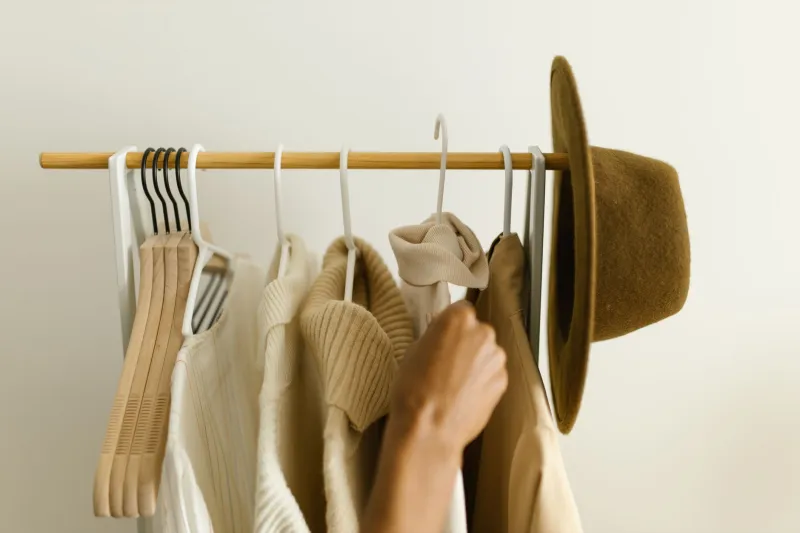
When Your Wardrobe Knew You Then But Doesn't Know You Now

Photo: Shixart1985, CC BY 2.0, via Wikimedia Commons
There's a specific kind of discomfort that happens when you open your closet and feel like a tourist. Everything in there belongs to someone, just maybe not the version of you standing in front of it right now. You bought it all. You loved it, or at least liked it enough to spend money on it. But somewhere between then and now, you changed — and the clothes didn't.
This isn't a shopping problem. It's a relationship problem.
Your wardrobe is a record of who you've been. And just like an old journal entry, some of it still resonates and some of it makes you wince. The question worth asking — the one most style advice skips entirely — is which is which.
The Wardrobe-Identity Gap Is More Common Than You Think
Most of us don't change dramatically overnight. It happens in layers. A promotion that shifts how you want to be perceived in a room. A breakup that quietly untangles you from aesthetic choices that were never fully yours to begin with. Moving to a new city. Turning 30, or 40, or 50 and realizing the person you were performing for doesn't exist anymore.
Each of these transitions leaves residue in your closet. The blazers from the job you outgrew. The going-out tops from a social life that no longer fits your energy. The "aspirational" pieces bought for a version of yourself you were trying to become but ultimately didn't.
None of this makes you irresponsible or indecisive. It makes you human. The issue only becomes a real one when the gap between your closet and your current identity gets wide enough to affect how you move through the world — when getting dressed starts to feel like putting on a costume instead of just getting dressed.
What "Old You" Clothes Actually Feel Like
Before you can do anything useful with your wardrobe, you need to get honest about what's in there and why.
Old-self pieces have a distinct energy. They're often the ones you skip over instinctively in the morning without totally knowing why. They fit fine. They're in good condition. But something makes you reach past them. That hesitation is data.
Ask yourself:
- Does this piece reflect how I actually want to show up today, or how I used to want to show up?
- Would I buy this right now, knowing everything I know about my life?
- Does wearing this feel like me, or does it feel like a character I used to play?
The answers don't have to be dramatic. Sometimes "old you" just means the version of yourself from three years ago who was in a different headspace. That's enough of a gap to matter.
The Pieces Worth Keeping — Even If They're Old
Here's where it gets nuanced, and where a lot of wardrobe advice goes wrong: not everything old needs to go.
Some pieces have grown with you. A well-cut trench coat you've had for a decade that still makes you feel like yourself every time you put it on. A pair of earrings that have traveled through three different life chapters and somehow feel right in all of them. A dress that fit the person you were becoming before you even knew you were becoming her.
These are the pieces that have what I'd call staying power — not because they're expensive or because they're classics in the traditional sense, but because they've remained in alignment with your core identity even as the surface stuff shifted.
The test is simple: does this piece feel like you, or does it feel like a version of you that you've moved past? One answer keeps it in the rotation. The other starts the conversation about letting go.
The Friendship Test
Think about your closest friendships — the ones that have lasted through multiple chapters of your life. What makes them work isn't that those friends knew you at your best or at your most polished. It's that they've kept up. They've stayed curious about who you're becoming, not just who you were.
Your wardrobe deserves the same standard.
A piece earns its place not by being expensive or by having a good story attached to it, but by still being relevant to the person you are right now. It's a small but meaningful shift in how you evaluate what stays and what goes.
Try this: the next time you're holding something you're unsure about, don't ask "do I love this?" Ask "does this still know me?" It sounds a little woo, but it cuts through the noise faster than almost any other question.
A Practical Framework for the Edit
You don't need a full weekend and a label maker to do this well. You need about 45 minutes and some honesty.
Start with the skips. Pull out every piece you've been bypassing for more than two months. Don't justify them yet — just get them in front of you.
Sort by era, not category. Instead of organizing by type (tops, bottoms, dresses), try to mentally group things by the life chapter they belong to. This makes the identity gap visible in a way that a standard closet cleanout doesn't.
Run the friendship test on each pile. Does this piece still know me? Keep or release.
Give yourself a grace pile. Some things are genuinely transitional — pieces you're not sure about yet because you're still figuring out who you're becoming. That's okay. Give them a defined window (say, 60 days) and revisit.
Moving Forward Without the Pressure to Replace Everything
Here's the part that doesn't get said enough: releasing the old-self pieces doesn't automatically mean you need to go buy new ones. Sometimes the edit is the answer. Sometimes clearing out what doesn't fit your current identity is enough to make what remains feel like a completely different wardrobe.
And when you do add something new — whether that's one piece or ten — let your current self do the choosing. Not the self you're hoping to become, not the self you used to be. The one standing in the dressing room right now, living the actual life you're living.
That's the version of you worth dressing. And honestly? She has pretty good taste.