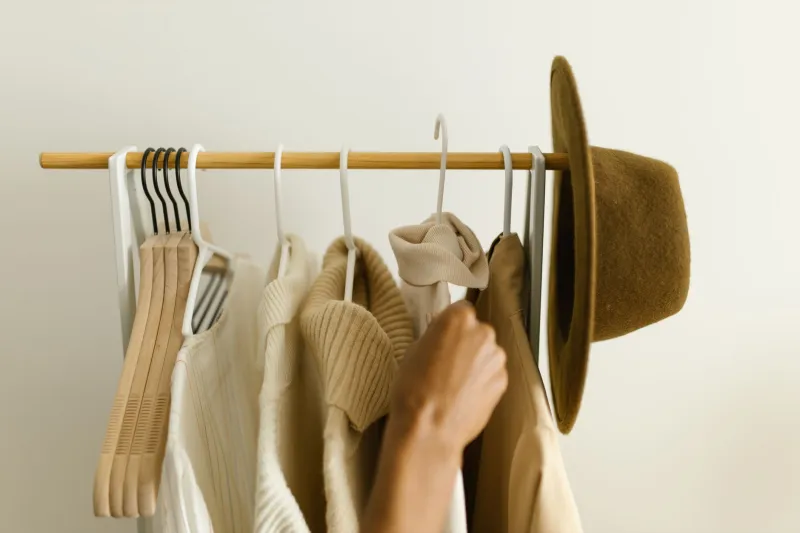
When Your Favorite Outfit Starts to Feel Like a Stranger

It happens to everyone, and it's deeply disorienting the first time it does.
You reach for the piece you've worn on rotation for two years — the one that always made you feel like yourself, the one that got compliments, the one you'd mentally categorized as a forever piece — and it just... sits there. On your body, looking technically fine, but feeling completely wrong. Flat. Like wearing someone else's clothes.
So you stand in front of the mirror for a few minutes, trying to figure out if you need to accessorize differently or if the lighting is off. And then a small, expensive thought creeps in: maybe I just need something new.
Sometimes that's true. Often, it isn't. Let's figure out which one you're dealing with.
Fashion Fatigue Is Real — But It's Misdiagnosed Constantly
Fashion fatigue — that dull, restless feeling when your wardrobe stops exciting you — is a completely normal part of having a relationship with clothes. Style isn't static. You change, your life changes, your context changes, and sometimes your wardrobe hasn't caught up.
But the fashion industry has a vested interest in you interpreting every moment of wardrobe boredom as a shopping problem. New season, new you, new pieces — it's a very profitable narrative, and it's one that most of us have absorbed so thoroughly that it feels like common sense.
The reality is more nuanced. Fashion fatigue usually has one of three causes, and only one of them actually requires buying something new.
Cause one: genuine style evolution. You've grown, your aesthetic has shifted, and the piece genuinely no longer reflects who you are. This is real, it happens, and it's okay to let things go.
Cause two: context fatigue. You've been wearing the piece the same way, in the same contexts, with the same other pieces, for so long that your brain has stopped seeing it. The piece is fine — your styling of it has gone stale.
Cause three: temporary restlessness. You're bored in general, or stressed, or in a life transition, and your wardrobe is absorbing that energy. This one has nothing to do with clothes and everything to do with what's happening internally.
The problem is that all three feel identical in the moment. They all produce the same "I have nothing to wear" spiral. Which means if you go straight to shopping, you're probably solving the wrong problem two out of three times.
How to Tell the Difference
Here's a simple diagnostic that actually works.
The 30-day test. Put the piece you're bored with aside — don't donate it, just move it out of your immediate rotation — for a month. When you come back to it, what's your reaction? If it's neutral or positive, context fatigue. If it's still flat or actively wrong, style evolution. If you forgot about it entirely and didn't miss it, that tells you something too.
The new-context experiment. Before you write off a piece, try it in a completely different way. If you've always worn your blazer to work, wear it on a weekend with jeans and sneakers. If your silk slip dress has only ever been a going-out piece, try it with a chunky knit and boots for daytime. Context shifts are genuinely transformative and cost absolutely nothing.
The "who was I" question. Think back to when you bought the piece and loved it. What was going on in your life? What were you dressing for? If your life has shifted significantly — new job, new city, relationship change, a genuine shift in how you spend your time — the piece may simply belong to a chapter that's closing. That's not a failure. That's evolution.
The honest feeling check. When you put it on and it feels wrong, is the feeling "this isn't me anymore" or "I've just seen this too many times"? One is information about identity. The other is information about variety.
The Real Cost-Benefit of Refreshing vs. Replacing
Let's talk numbers for a second, because this is where the rubber meets the road.
Say you have a $150 cashmere sweater you've worn 40 times. Your cost-per-wear is $3.75. If you wear it 20 more times, it drops to $2.50. If you replace it with a new $150 sweater because you're bored, you're starting that math over from zero — and statistically, the novelty excitement of the new piece will wear off in about the same amount of time.
Now, if you can revive the existing piece — a new way of wearing it, a different tuck, layering it under something you haven't tried — and get those 20 additional wears, you've essentially saved $150 and kept your cost-per-wear trending down.
The wardrobe refresh — buying new pieces to inject life into an existing closet — is genuinely sometimes the right call. But it works best when you're adding something that genuinely fills a gap, not something that just recreates the novelty hit you got from the piece you're currently bored with. Because you'll be bored with that one too, in about six months.
Practical Ways to Fall Back in Love With What You Have
Reorganize your closet by outfit, not by category. Instead of all tops together and all bottoms together, group things into complete looks. You'll start seeing combinations you've never tried.
Introduce one new element rather than a whole new piece. A different belt, a scarf, a shoe you haven't worn in a while — small additions can make existing pieces feel completely new without the full investment of a new purchase.
Photograph your outfits for a week. Not for social media — for yourself. Seeing your outfits from the outside often reveals combinations you'd dismissed or forgotten, and it gives you a different perspective on what you actually have.
Do a deliberate rediscovery session. Once a season, pull out things you haven't worn recently and actually try them on. Not to decide whether to keep or donate — just to see them with fresh eyes. You'll be surprised how often something you'd mentally written off lands differently when you're not on autopilot.
Boredom Is a Compass, Not a Credit Card Invitation
When your favorite pieces start feeling like strangers, the instinct to shop is understandable. But that boredom is actually useful data — it's telling you something about where you are, what you've outgrown, or where your creativity has gone stale.
Listen to it before you spend anything. More often than not, the answer isn't in a new piece. It's in a new perspective on what's already hanging in your closet, waiting for you to see it differently.