What the Pieces You Never Wear Anymore Are Actually Trying to Say

Photo by Photo by Priscilla Du Preez 🇨🇦 on Unsplash on Unsplash
There's a section of almost every woman's closet that doesn't get talked about enough. It's not the front-and-center stuff you reach for on autopilot every morning. It's the back row — the pieces that have been hanging in the same spot for two, three, maybe five years. The blazer you bought for a job interview you killed. The dress that felt like you in the store and then somehow never felt like you again. The jeans that fit perfectly in 2019 and now live in a kind of limbo you haven't been able to resolve.
Most style advice tells you to pull it all out, ask yourself if it sparks joy, and donate whatever doesn't make the cut. And honestly? That's not bad advice. But it skips over something genuinely useful — the information those pieces are carrying about your own evolution.
Your oldest, least-worn pieces are essentially a personal archive. And if you're willing to dig in with a little curiosity instead of just a garbage bag, they can tell you something real.
Start With the Emotional Layer
Before you start sorting by color or silhouette, start by asking yourself how you feel when you pick each piece up. Not whether you'd wear it tomorrow — just how it lands emotionally.
Some pieces will feel like relief. You forgot you had them, and now you're glad you do. Others will feel like guilt — you spent too much, wore it once, and it's been haunting you ever since. And some will feel like something harder to name: a version of yourself you've moved away from, or a life chapter that closed before you were ready for it to.
All of that is data. Not judgment — data.
The guilt pieces usually need to go. Holding onto something because you feel bad about the purchase isn't honoring the piece; it's just extending the financial regret. Let it go, learn the lesson, and move forward.
But the ones that bring up something more complex? Those are worth sitting with.
The Identity Clues Hidden in Old Purchases
Here's what I've noticed in my own closet and in conversations with women about their wardrobes: the pieces you stopped wearing usually stopped working for one of three reasons.
Your life changed. The blazer you wore to that interview belongs to a professional context that might look different now. The cocktail dresses from your late twenties were bought for a social life that's shifted. These pieces aren't wrong — they just belong to a different chapter.
Your taste evolved. Maybe you went through a maximalist phase and then quietly moved toward something more pared down. Or the reverse — you spent years in neutrals and now you're drawn to color. The pieces left behind from those phases are like breadcrumbs. They show you the direction you've been traveling.
You bought for who you wanted to be, not who you actually are. This one's the most common, and it's the most useful to catch. We all do it — buy the linen trousers because we want to be the kind of woman who wears linen trousers effortlessly, even though every time we put them on we feel vaguely uncomfortable and end up changing. Those aspirational pieces are worth examining closely, because sometimes the aspiration is worth chasing, and sometimes it's just a story you've been telling yourself.
Which Pieces Are Worth Keeping (Even If You're Not Wearing Them)
Not everything that hasn't been worn recently needs to leave. Some pieces have what I'd call archive value — they're not currently active in your rotation, but they belong to your style story in a way that's genuinely worth preserving.
A really beautiful coat that's slightly too formal for your current day-to-day but is impeccably made? Keep it. Your life will have formal moments again. A vintage piece that belonged to a family member or that you found on a trip that meant something to you? Keep it, even if it never gets worn, because some things in a wardrobe aren't about utility.
The test isn't do I wear this constantly — it's does this piece belong to who I am or who I'm building toward? If the answer is yes to either, it earns its space.
How to Actually Use What You Find
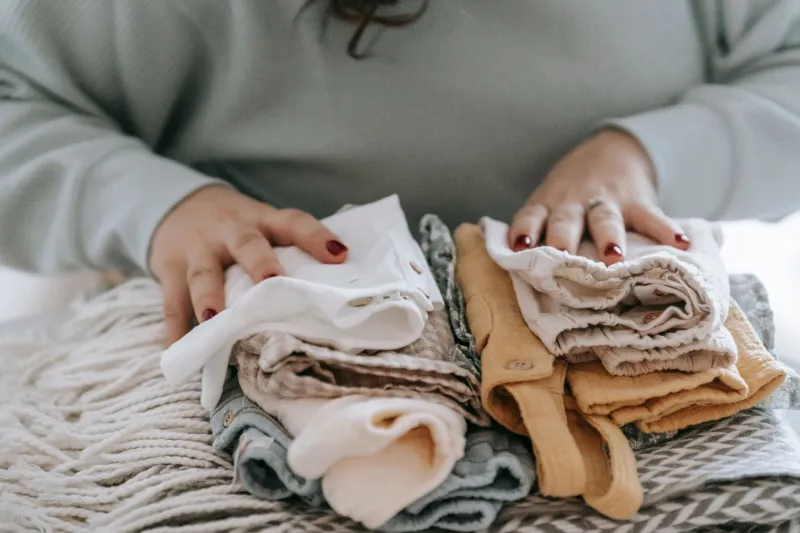
Once you've done the emotional inventory, get practical. Pull out every piece that's been dormant for more than a year and lay them all out somewhere — your bed, your floor, wherever you have space.
Look at them as a collection. Not as individual items, but as a group. What patterns do you notice? Are they all a specific color family you've drifted away from? Are they all a certain formality level that doesn't match your current life? Are they all pieces that require more effort to style than you typically have energy for?
That pattern is telling you something about the gap between the wardrobe you've been building and the one you actually need.
From there, make three piles: release, reactivate, and archive. Release goes to donation or consignment. Reactivate means you're going to intentionally work it back into rotation — maybe it just needs to be styled differently, or paired with something newer to feel fresh again. Archive is the small, intentional collection of pieces that are staying for reasons beyond wearability.
The Bigger Picture
Your wardrobe is a living document of your life. The pieces you've accumulated over the years aren't just fabric and stitching — they're a record of who you were trying to be, who you actually were, and who you've grown into since.
Digging into the forgotten corners isn't about feeling bad for the money you spent or the trends you chased. It's about getting honest with yourself in a way that makes future decisions easier and more intentional.
When you understand the patterns in what you've kept and what you've stopped reaching for, you stop making the same purchases on autopilot. You start building a wardrobe that's actually aligned with your real life — not the aspirational version, not the past version, but the one you're living right now.
And that? That's a wardrobe that actually works.