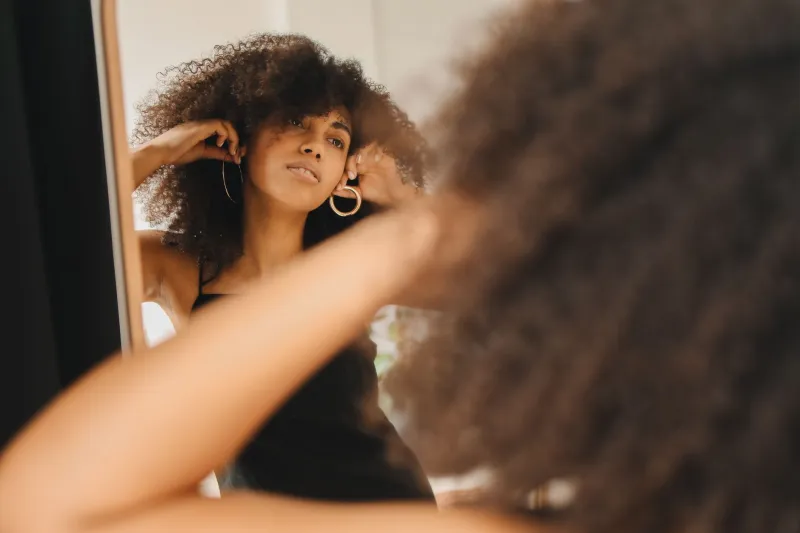
When Playing It Safe Becomes Playing It Small: Breaking Free From Your Style Comfort Zone

There's that one outfit. You know the one. The jeans that fit just right, the top you've worn so many times it's practically molded to your body, the boots that go with literally everything. You put it on without thinking, feel instantly okay, and walk out the door. Done.
And honestly? There's nothing wrong with that — until there is.
Because somewhere between "this works" and "this is all I ever wear," something quietly shifts. Your reliable go-to stops being a foundation and starts being a ceiling.
The Psychology Behind Comfort Dressing
Humans are wired to repeat what feels safe. It's not laziness — it's actually your brain being efficient. When you've worn something that got you through a hard day, a big meeting, or just a Tuesday where nothing else went right, your nervous system files that outfit under reliable. And reliable feels really good when the rest of life feels unpredictable.
Dressing from that place isn't a character flaw. It's self-protection. The problem is that self-protection, when it runs on autopilot, can quietly become self-limitation.
Stylewise, this shows up as what a lot of people call a "uniform" — but not the cool, intentional kind. The kind where you look back at three years of photos and realize you've basically been wearing the same thing over and over while the world moved around you. The kind where you open your closet and feel bored before you even touch a hanger.
When Your Uniform Stops Working For You
There are a few signals worth paying attention to:
You feel invisible in your own clothes. Not understated — invisible. There's a difference between dressing with quiet confidence and dressing to disappear. If getting dressed feels more like camouflage than expression, that's worth sitting with.
You've stopped noticing what you put on. Comfort can become numbness. If you can't remember what you wore yesterday, or the day before, or last Thursday, your clothes might have become background noise instead of something that actually reflects who you are right now.
You feel a little envious when someone else takes a risk. That flicker of "I could never" when you see someone wearing something unexpected? That's not admiration — that's information. It's telling you there's something you want that you haven't let yourself try yet.
Your style hasn't changed since a specific moment in your past. A lot of people's wardrobes are frozen in time — frozen at the last point they felt really good about themselves, or the last time they had energy to experiment. If your closet is a time capsule, it might be holding a version of you that you've already outgrown.
The Real Cost of Playing It Safe
Here's what nobody really talks about: staying in your style comfort zone has a cost, even if it doesn't show up on a receipt.
When you stop experimenting, you stop learning what you actually like. Your taste calcifies. You walk into a store and feel overwhelmed because everything looks foreign — not because your style is so refined, but because you've stopped practicing the muscle of choosing.
You also start conflating familiar with authentic. Just because something feels like you doesn't mean it's the most true version of you. Sometimes the thing that feels most like "you" is just the thing you've worn the longest.
How to Push Without Losing Yourself
The goal here isn't to blow up your wardrobe or suddenly dress like someone you don't recognize. That's just swapping one kind of disconnection for another. The goal is gentle expansion — trying things that sit just slightly outside your usual territory.
Start with one layer. If your base outfit feels non-negotiable, fine. Keep it. But add something new on top — a different jacket, a scarf you've been afraid to wear, a bag in a color you'd normally talk yourself out of. One variable at a time takes the pressure off.
Shop outside your automatic categories. If you always head straight for the neutrals, give yourself five minutes in the color section before you leave the store. You don't have to buy anything. You're just training your eye to consider more.
Borrow before you commit. A lot of women avoid experimenting because they don't want to spend money on something they might not love. Fair. But apps like Rent the Runway exist for exactly this reason — so does your friend with the great wardrobe who's roughly your size. Try before you decide it's not for you.
Take photos. Not for anyone else. Just for you. Sometimes the outfit that feels weird in the dressing room looks completely different in a photo — better, actually. Your brain adjusts to the unfamiliar faster than you think.
Give it three wears. The first time you wear something new, you'll probably feel self-conscious. The second time, a little less. By the third wear, it usually starts to feel like yours. Most people give up after the first.
The Difference Between a Foundation and a Rut
None of this means your reliable pieces are the enemy. A great-fitting pair of jeans and a white button-down that works every time? Those are tools. They're supposed to be easy. The point isn't to make getting dressed harder — it's to make sure the easy pieces are supporting a style that's still evolving, not replacing one entirely.
Think of your comfort pieces as the baseline, not the whole story. They give you something solid to come back to when you're tired or uncertain. But they shouldn't be the only chapter.
The most interesting wardrobes — the ones that feel genuinely personal — are built by people who know their anchors and know when to let themselves drift a little. They're not reinventing themselves constantly. They're just staying curious.
One Small Move
If you're reading this and recognizing yourself a little too clearly in the comfort trap description, here's the only thing I'd suggest doing today: go into your closet and pull out one piece you've never actually worn, or haven't worn in over a year. Something you bought because it felt exciting and then quietly avoided.
Try it on. Not to go anywhere. Just to remember what it feels like to consider something new.
That's it. That's the whole assignment.
Sometimes the smallest shift is enough to remind you that your style isn't finished yet — and that's actually a really good thing.