Nobody's Watching — So Why Does It Still Matter What You Wear?

There's a version of Sunday morning that most of us know really well. Oversized college shirt from 2014. Pajama pants with a broken drawstring. Fuzzy socks that don't match. Nobody's coming over, there's nowhere to be, and honestly? It feels fine in the moment.
But here's the thing I've been thinking about a lot lately: how does that version of you actually feel by noon? Not physically — but mentally. Are you motivated? Clear-headed? Ready to tackle anything on your list, even the small stuff?
For most people, the honest answer is no. And the clothes might have more to do with that than we want to admit.
The Psychology Nobody Brings Up in Loungewear Hauls
There's a concept researchers call "enclothed cognition" — the idea that what we wear influences how we think and behave. It's not just about looking good for other people. The clothes we put against our bodies send signals directly to our brains about who we are and what mode we're in right now.
When you're wearing something that signals "I've given up on today," your brain gets that message loud and clear. And it responds accordingly.
This isn't about pressure or perfectionism. It's not about getting dressed up to sit on your couch. It's about the real, measurable difference between intentional comfort and default comfort — and why one of them actually serves you while the other kind of just... doesn't.
Comfort Isn't the Problem. Carelessness Is.
Let me be clear: I am fully pro-comfort. Soft fabrics, relaxed fits, no waistband digging into your ribs — all of it, yes. The goal here is never to make you feel like you have to perform even inside your own home.
But there's a difference between choosing comfort deliberately and defaulting to whatever requires the least thought. One is an act of self-care. The other is closer to self-neglect, even if it doesn't feel that way in the moment.
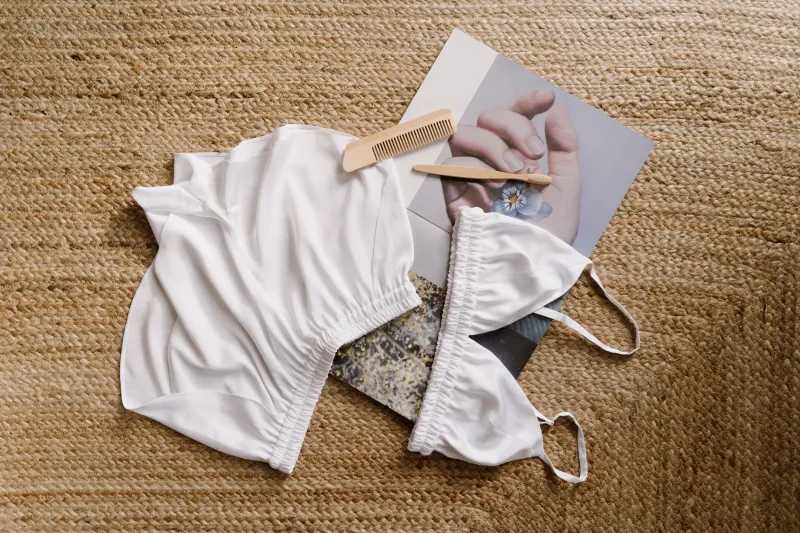
Think about the last time you put on a matching set — even a simple one, even from Target — instead of grabbing whatever was on the floor. Did the day feel slightly different? There's a reason for that. When you make a choice, even a small one, about how you want to show up, you're setting a tone for yourself. You're signaling to your own nervous system: I'm worth the ten seconds it took to pick this out.
That's not a small thing.
What "Intentional Homewear" Actually Looks Like
It doesn't mean matching sets from a luxury brand (though honestly, if that's your thing, go for it). Intentional homewear is really just about having pieces you chose rather than pieces you ended up with.
A few things that tend to make the biggest difference:
Fit matters, even at home. Drowning in fabric that's three sizes too big doesn't feel cozy after a while — it starts to feel shapeless in a way that bleeds into how you carry yourself. A relaxed fit is different from a fit that's just... wrong. Know the difference in your own wardrobe.
Color does something to your mood. This is well-documented and also just something most of us intuitively know. Wearing the same faded gray every single day at home isn't neutral — it's a choice with consequences. Soft neutrals, warm tones, even a pop of something unexpected can shift your energy in a way that's hard to explain but very easy to feel.
Fabric quality is a real investment. You spend more hours in your home clothes than almost anything else you own. The cost-per-wear math on a really good set of loungewear is genuinely better than most "going out" pieces. Treat it like the wardrobe category it actually is.
The Work-From-Home Factor
If you work remotely — and a lot of us do, at least part of the time — this conversation becomes even more urgent. The boundary between "home mode" and "work mode" is already blurry. What you wear is one of the few physical cues you have left to help your brain make that distinction.
This doesn't mean you need to put on a blazer for your 9 AM Zoom. But it probably does mean that staying in last night's sleep clothes until 3 PM is working against you, not for you. Even a simple swap — same cozy vibe, but a fresh set you actually chose for the day — can help your brain clock in in a way that matters.
A lot of women I know have created what I'd call a "home uniform" — a go-to combination that's comfortable enough to wear all day but intentional enough that they feel like themselves in it. That's the sweet spot. Find yours.
The Deeper Thing This Is Really About
Here's what I think is actually going on underneath all of this: how we dress at home is a reflection of how much we think we deserve to feel good when no one's looking.
We'll spend real time and real money curating what we wear out into the world. We'll think about fit, about color, about the message we're sending. And then we'll spend the majority of our actual lives — the quiet hours, the slow mornings, the working afternoons — in whatever's leftover.
That math doesn't add up. And I think a lot of us feel it without quite naming it.
Dressing intentionally at home isn't about aesthetics for their own sake. It's about extending the same care to yourself in private that you'd extend in public. It's about deciding that the version of you sitting at your kitchen table with your coffee deserves to feel put-together and calm and like herself — not just the version of you walking into a room full of people.
Where to Start If You Want to Actually Change This
You don't need to overhaul anything. Start with one swap. The next time you reach for the broken-drawstring pants, pause and grab something you actually like instead. Notice how the day feels different. That's all the evidence you need.
From there, it's worth doing a quick audit of what you actually have for home. If most of it is stuff you'd never consciously choose — things that just accumulated over the years — that's useful information. You don't have to replace everything at once, but you can start editing toward pieces that make you feel like a person who has her life together, even on a Tuesday when nobody's coming over.
Because here's the real thing: style isn't just what you wear out. It's what you're building every single day, in every context — including the ones where the only audience is you.
And honestly? That audience might be the most important one of all.